
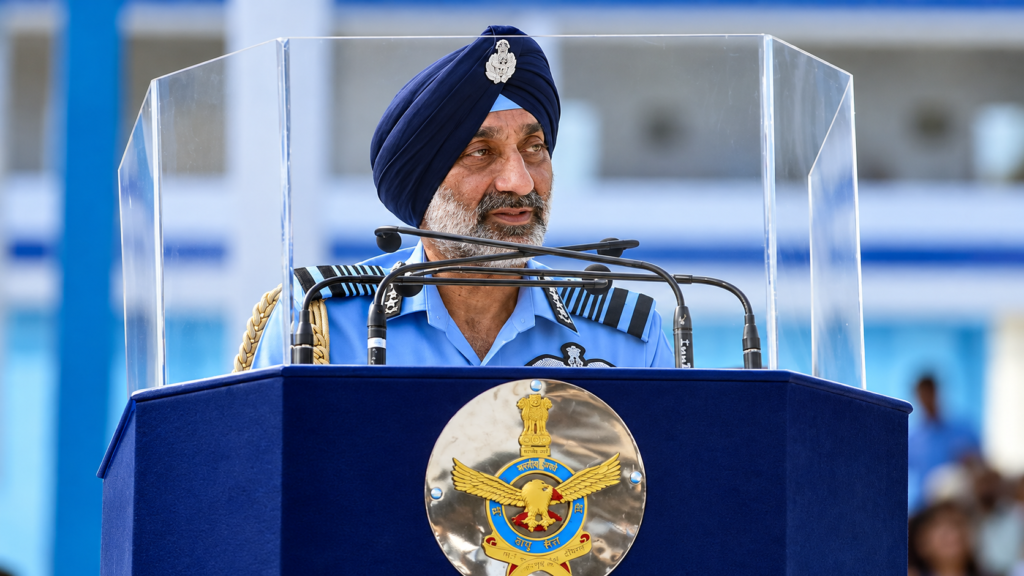
Just days before he hung up his uniform, outgoing Indian Air Force chief Air Chief Marshal AP Singh put pen to paper and made a quiet but firm pitch to the government. On 26 October, with his retirement set for 31 October, he wrote to Defence Minister Rajnath Singh urging that the IAF retain control of a prime chunk of land inside the Race Course Air Force Station in New Delhi. The land, roughly 40 acres, houses the Air Force Sports Complex — the golf course, swimming pool, guest cottages, fitness centre and restaurants that have long been part of station life.
People familiar with the letter say Singh pointed to operational needs and the facilities already sitting on the ground. He asked the defence minister to step in, direct the authorities to hand the land over to the IAF, and take another look at the whole transfer and regularisation process involving Ministry of Housing and Urban Affairs land at the station. One official who has been tracking the matter put it simply: Singh felt it was prudent for that land to stay under Air Force control.
The letter landed against the backdrop of a move that had already stirred quiet unease in defence circles. Last month the sports complex was shut to members until further notice. The closure came as the housing ministry, through the Land and Development Office, moved to reclaim the land that had been allotted to the IAF years ago. HT first reported the shutdown on 28 October. Members got messages saying the complex would stay closed from early morning on the 28th. Staff were told not to report. The abrupt halt also forced the cancellation of the traditional “golfing-out” farewell that outgoing chiefs usually get as patrons-in-chief of the course. Timing raised eyebrows because the event had been lined up for the very day the gates closed.
The Race Course station itself sits a stone’s throw from the Prime Minister’s residence on Lok Kalyan Marg. It dates back to the 1940s and has grown into far more than a sports venue. Singh’s letter spelled out the station’s wider role: administrative support to Air Headquarters and more than 5,000 personnel, married and unmarried accommodation, training areas for airmen and Agniveervayus, security set-up, a medical centre, a school, a unit-run canteen, and the recreational facilities. Officials also note that the station helps counter unmanned aerial system threats during activities coordinated by the Delhi Integrated Air Defence Centre.
MoHUA has not publicly detailed why it wants the land back, but the step fits a broader pattern of reclaiming large parcels near the PM’s residence. The Delhi Gymkhana Club and Jaipur Polo Ground have already been in the same conversation. The Land and Development Office has completed its survey of the sports complex, which now sits unused. The defence ministry has not commented on the letter.
IAF historian Anchit Gupta has traced the station’s long association with the Race Course area. It goes back to the Second World War, when parachutists trained nearby and an RAF station was set up in 1942. After Independence the Royal Indian Air Force created an administrative wing there in September 1947. It quickly became a nerve centre for personnel records, accounts, medical support, security, accommodation and movement of airmen. In the chaos of Partition riots its people patrolled areas, helped set up refugee camps and housed families arriving from Pakistan. It later provided transport and logistics during the 1947-48 Kashmir operations and even held Pakistani Air Force prisoners of war during the 1971 conflict.
The sports complex itself has been a familiar space for serving officers, veterans and their families — a place for a round of golf, a swim, or a quiet meal. Its sudden closure left many wondering about the future of those facilities and the training areas used by younger personnel. Some sources had already conveyed to the authorities that the land is not just about recreation; it supports training and morale. The new Air Chief, Air Chief Marshal Ashutosh Dixit, who took over on 1 November, has spoken of giving personal attention to the training, professional excellence, morale, safety, welfare and dignity of air force personnel. Officials expect him to take the conversation forward.
For now the complex remains closed, the survey is done, and the letter from the outgoing chief sits with the defence minister. What happens next will decide whether the IAF keeps the land that has been part of its Delhi footprint for decades or whether the government reclaims it as part of the larger drive around that high-security stretch of the capital. The episode has already shown how quickly a long-standing facility can become the centre of a quiet institutional tug-of-war.
**Sources**
– Hindustan Times exclusive reporting by Rahul Singh (3 November 2026 and earlier 28 October 2026 coverage)
– Statements from officials familiar with the matter (anonymity requested)
– IAF historian Anchit Gupta on the station’s history
– Related coverage in The Tribune, Indian Express, ABP Live and other reports on the closure and land reclamation moves
@Rohit Manral